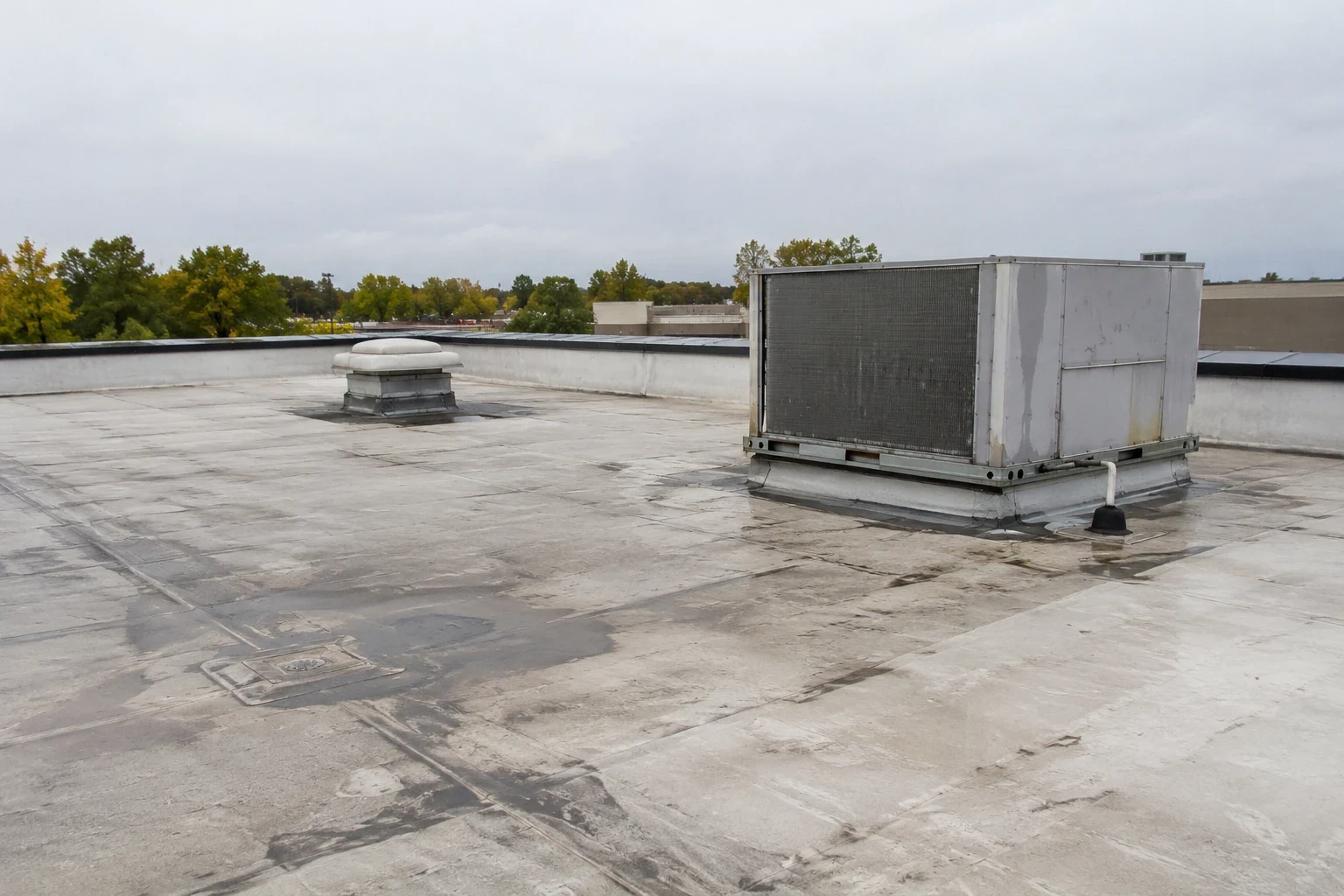
The store manager calls after a November gust because a ceiling tile above aisle nine is stained, and dispatch asks first where the nearest roof edge sits. The late-November 2019 windstorm put gusts past 50 mph over the valley, and a wide, flat roof catches that kind of wind at every edge. Keep customers away from the stained area, move product if you can, and leave the roof alone until a crew arrives.
Send the store address, the roof plan if you have it and the sales areas that cannot close. We sequence the first visit from that list.
Check the Edges First After a Gale
The county designs to a wind speed of 110, and the city's record gust is 69 mph from May 1985. On a large retail roof the edge metal, the parapet cap and the corner flashing see the highest uplift, so a gust-lifted edge is the first suspect after any storm. An edge that lifts and settles back leaves almost no mark from the parking lot.
Caps get tested by hand, fastener spacing gets measured and the seams behind them get probed. A cap that moves under a gloved hand will move again in the next gale. Every repair goes on the roof map with a before-and-after photograph of the corner.
Rooftop screens and sign mounts need the same look. A screen panel that vibrates in a gust works its fasteners loose over a season, and a loose sign mount is both a leak and a safety problem. We tighten what we can on the visit, replace what is worn and flag anything that belongs to the sign or mechanical contractor.
Study the Valley's Retail Cluster
Valley Mall and surrounding big-box retail in Union Gap form the main retail roof inventory for the valley, and Walmart is among the top employers in the area with about 1,700 people. Union Gap sits where U.S. 97, Interstate 82, Thorp Road and the BNSF Railway pass through the gap, so deliveries, trucks and crane access all follow those corridors.
Big retail roofs share a few traits. Drain runs are long, rooftop units are many, service crews wear paths into the sheet and the sales floor stays open under the work. Work in Union Gap follows a plan built for those four traits. The first visit identifies the roof system, because a store's size says nothing certain about its roof type.
Service traffic is the quiet cost of a big roof. Technicians reach the units by the same few routes every month, and the sheet wears along those paths first. We map the routes, recommend walk pads where wear shows and add a roof access log, so every vendor visit carries a name, a date and a note of what was touched. The log protects the warranty and shortens the search when a leak appears.
Respect the Drift Behind Every Tall Wall
Snow averages about 21.6 inches a year in Yakima, mostly in December and January, and big-box roofs gather it against the tall front, against rooftop unit enclosures and at every step in the roofline. Steel tools cut membrane, so plastic tools clear the drift and a protective layer stays down. Stuck doors or cracks in the sales-floor ceiling signal deflection. A midday thaw sends water to a drain that is still frozen shut from the night, and the pond rides back against the flashing. Clearing the drain and scupper by hand before a freeze costs little and prevents most thaw leaks. Facility teams can do it with plastic tools from a safe position, or call us to do it.
Plan for 40 Hot Afternoons
Yakima logs around 40 afternoons at 90 F or hotter, and its record stands at 113 F. A dark sheet over a big store soaks that heat, and rooftop units fight it all summer. Large daily temperature swings tug at seams and curb flashings, and a unit that was set on a hot day can leave a gap by the cold nights of autumn.
We schedule adhesive work for early mornings and pause in the afternoon peak. A reflective TPO sheet cuts surface temperature, and the choice of colour belongs in the replace-or-recover conversation. Each unit gets a flashing check at the spring walk.
Reflectance matters most on a roof this large. A clean, light surface runs cooler than a dark or dirty one, and the cooling bill follows. A spring wash and a condition grade keep the surface in check, and the file shows when a recoat or a recover starts to pay. Loading-dock canopies and vestibule roofs sit lower than the main deck and take the runoff, so they get the same spring look as the field.
Price the Decision With the Drivers Named
A dry roof with sound seams can take a recover and skip the tear-off, which keeps the sales floor quiet. Trapped moisture rules that out in the wet section, and a drone roof inspection plus an infrared pass maps it without traffic on the sheet. Washington's 2021 code editions, in force since March 15, 2024, set insulation and energy requirements for a new assembly. Holiday blackout dates go on the calendar first.
Keep the Store Open and the Record Current
The roof is phased by section, the interior gets a leak watch and every opening closes the same day. At the end, seams, caps, drains and curbs are walked and written up, and the store receives a roof map, photos and a penetration log. A store inside a shopping center or beside a grocery store can use the same file format, one entry per section.
A walk each spring, with seams re-probed, drains cleared and photos retaken, keeps the file honest.
A corporate real-estate team that weighs a roof bid against the store's capital plan gets a one-page summary of each option, its cost drivers and its expected life, so that review moves quickly.
Ask the store for its receiving hours and its truck court layout on the first visit. Crane picks and hoist locations are chosen from that sketch, and a lift planned around the morning freight delivery rarely needs to be moved.
Commercial Roofing Questions
What should store staff do after a heavy gust?
Look at the ceiling below the roof edge and note any new stain, then send photos and the aisle number. Keep customers away, move product, and do not send anyone to the roof. We check caps, seams and corner flashing first, because edges lift before the field does.
Can a TPO recover go over an existing big-box membrane?
Yes, when the insulation is dry and the deck can carry the added layer. Moisture readings and core samples decide, and a recover and a replacement are priced side by side so the owner chooses with the whole picture.
How do you keep the sales floor dry during a reroof?
We open small sections, dry each one in the same day and keep a leak watch inside until it is sealed. If the forecast turns, the crew stops and seals. The bid shows how much float the schedule carries.
Why does the first visit check the corners?
Corners and edges see the highest wind uplift on a wide roof. A loose cap or lifted edge there often shows no mark from the ground, but it admits water in the next storm. We fix it before checking the field.
What documents should the store keep?
The roof map, the photos, moisture readings, a penetration log and the signed punch list. File them with the lease so a later contractor can tell which curbs are new and which are original.